Pistols, Rifles or Shotguns: A Beginner’s Guide
Pistol, rifle or shotgun — not sure which is which? Here's a beginner's guide to how each one shoots, feels, and fits a first trip to the range.
Pistols, Rifles or Shotguns: A Beginner’s Guide
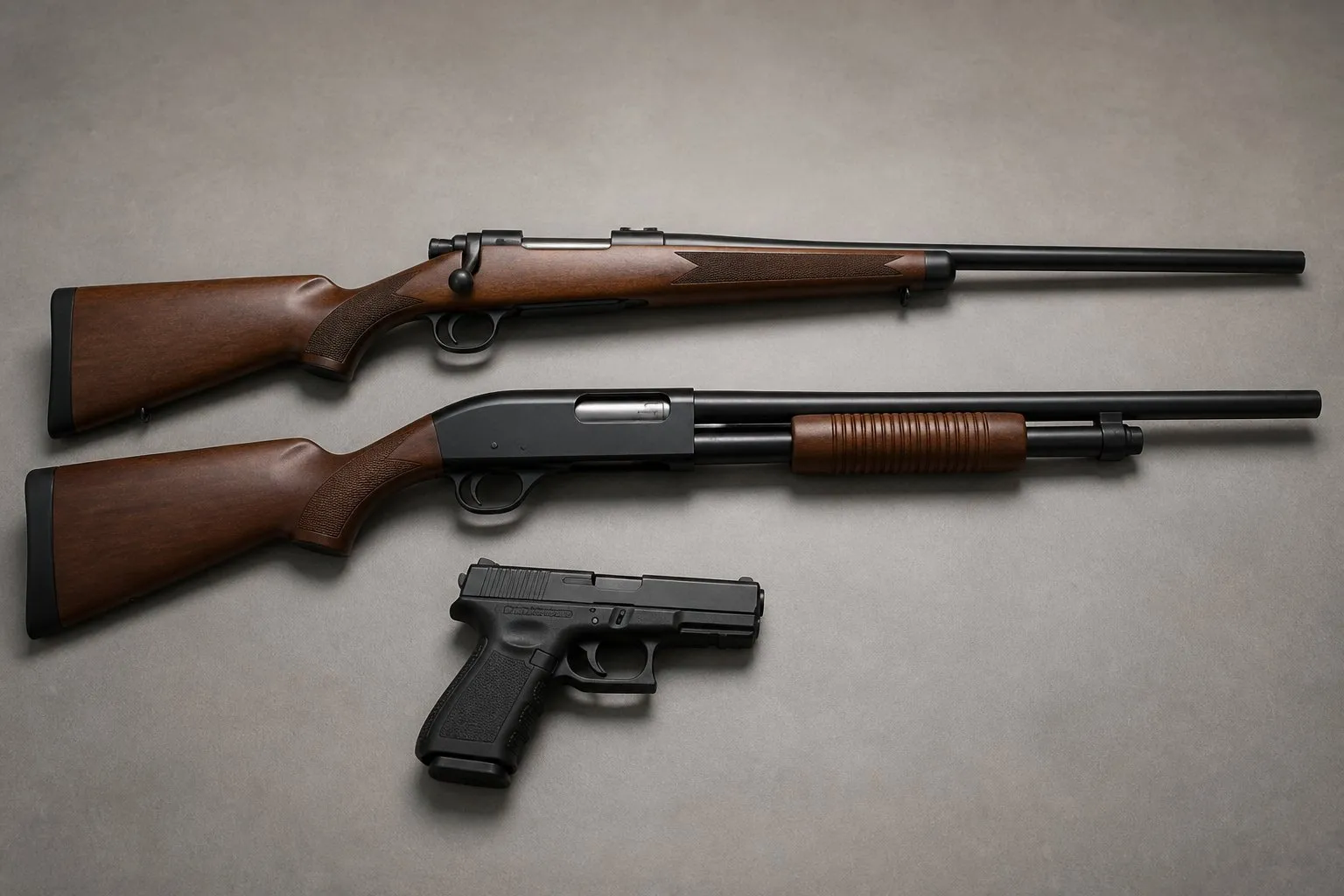
Stand on the firing line at Churchill Shooting Range Budapest and the first thing you notice is not the noise, it is the sheer variety of shapes in front of you. A compact pistol sits differently in the hand than a shoulder-fired rifle, and a shotgun's kick feels nothing like either. Knowing what separates these types of firearms turns a fun afternoon into a genuinely rewarding one, because you understand what you are holding and why it behaves the way it does.
Pistols, rifles and shotguns differ in size, how they are fired, the ammunition they use and the recoil they produce, and spotting those differences is the fastest way to feel confident on the range. Pistols are the smallest of the three, gripped with one or two hands. Rifles are shoulder-fired with a longer barrel built for accuracy over distance. Shotguns are also shoulder-fired but rely on a smooth interior barrel that spreads pellets rather than sending a single spinning bullet downrange.
Our American and British veteran instructors talk guests through each type of gun before a single round is loaded, covering the action (how the firearm cycles ammunition), the trigger feel, and what recoil to expect. That briefing matters more than any spec sheet, because target shooting rewards understanding as much as steady hands.
Pistols and Handguns: Compact Firearms With Distinct Actions
Pistols are compact, hand-held firearms designed to be fired with one or both hands rather than from the shoulder. The handgun family splits into two main patterns: revolvers, which rotate ammunition through a cylinder, and semi-automatic pistols, which cycle a round from a magazine into the chamber with every trigger pull.
What Is the Difference Between a Pistol and a Revolver?
A revolver stores its cartridges in a rotating cylinder, with each pull of the trigger turning the cylinder to line up a fresh round with the barrel. Classic examples include the Smith & Wesson Model 10 and the Colt Python, both recognisable by that distinctive cylinder shape.
A pistol, in the stricter sense used by many shooters, feeds ammunition from a magazine housed in the grip and loads each round into a chamber built into the barrel itself. The Glock 19 and Beretta 92FS are well-known semi-automatic pistols built this way. Some historic and novelty designs are single-shot pistols, loaded and fired one round at a time with no magazine at all.
How Do Semi-Automatic Pistols Work?
Semi-automatic pistols use the energy from each fired cartridge to eject the spent casing and load the next round automatically, so one trigger pull equals one shot with no manual reloading between shots. This is what most first-time visitors picture when they imagine a modern handgun.
Trigger types vary. A single-action trigger only releases the hammer or striker, so the gun must already be cocked. A double-action, or DA/SA, trigger both cocks and releases the mechanism in one longer pull, which is why the first shot on some pistols feels heavier than the rest. Common calibres include 9mm and .45 ACP, both of which our instructors will point out during the safety briefing.
What Do Grip, Magazine, Chamber and Trigger Pull Mean?
The grip is simply where your hands hold the pistol, shaping how steady and controlled your stance feels. The magazine is the spring-loaded box that stores cartridges and feeds them upward into the chamber, the small compartment at the rear of the barrel where a round sits the instant before firing.
Trigger pull describes how much pressure and travel the trigger needs before the gun fires, and barrel length affects both accuracy and how much recoil you feel in the hand. Law enforcement agencies around the world favour semi-automatic pistols for exactly these reasons: reliable cycling, manageable recoil, and a trigger pull shooters can learn quickly under supervision.
Rifles: Why Rifling, Stocks and Actions Matter
Rifles are shoulder-fired firearms with a long barrel cut with spiral grooves, called rifling, that spin the bullet for greater accuracy and range. That spinning motion is the single biggest reason rifles feel and perform differently to handguns on the line.
What Makes a Rifle Different From a Handgun?
A rifle's defining feature is its rifled barrel: spiral grooves inside the bore that grip the bullet as it travels and set it spinning, much like a well-thrown rugby ball holds a truer flight path. The stock, the shoulder piece that runs along the back of the rifle, lets you brace the firearm against your body for a far steadier hold than any handgun grip allows.
Rifle cartridges are also longer and more powerful than typical pistol cartridges, launching the projectile at higher velocity. Guests trying the AR-15 or a bolt-action rifle for the first time at Churchill Shooting Range Budapest often say the shoulder brace alone makes the shot feel more controlled than they expected.
Bolt-Action, Lever-Action and Semi-Automatic Rifles Explained
Bolt-action rifles require the shooter to manually cycle a bolt handle after every shot, extracting the spent case and chambering a fresh round; the Remington 700 is a textbook example, prized for consistency and precision. Lever-action rifles use a lever near the trigger guard to achieve the same result, a mechanism popularised by classic Western-era firearms.
Semi-automatic rifles fire one round per trigger pull and cycle automatically, using the same principle as semi-automatic pistols but scaled up. The Ruger 10/22, chambered in .22 Long Rifle, is a gentle and popular introduction to this action type. Single-shot rifles, by contrast, must be reloaded by hand after every round, trading speed for simplicity.
Why Are Rifles Associated With Precision and Effective Range?
Rifling and a longer barrel combine to give rifles a far greater effective range than handguns or shotguns, which is why hunters and target shooters alike reach for a rifle when distance and precision matter. The stock, the added barrel length, and the spinning bullet all work together to keep the projectile flying true over greater distances than a pistol could manage.
This is also why rifles dominate long-range target shooting disciplines. A steady stance, a braced stock, and a well-rifled barrel do most of the work; the shooter simply needs a calm breath and a controlled trigger squeeze, something our instructors coach every guest through.
Shotguns: Smoothbores, Shells and Different Loads
Shotguns are shoulder-fired firearms with a smooth interior barrel, called a smoothbore, designed to fire a shotgun shell rather than a single rifle-style bullet. That smooth bore, free of the spiral grooves found in a rifle, is what allows a shotgun shell to release its contents in a spreading pattern.
How Does a Shotgun Differ From a Rifle?
A shotgun barrel is smoothbore, while a rifle barrel is rifled, and that single difference explains most of what separates the two on the range. The smooth bore reduces friction and lets shot spread naturally after leaving the muzzle, which suits moving or wider targets far better than a single precise bullet does.
Shotguns are measured in gauge (12 gauge being the most common) rather than the caliber measurements used for rifles and pistols. Some shotguns designed specifically to fire slugs include rifled barrels or rifled choke inserts, blurring the line slightly, but the standard smoothbore design remains the defining feature.
Shot, Buckshot and Slugs: What Can a Shotgun Fire?
A shotgun shell can hold birdshot (many small pellets for lighter, dispersed patterns), buckshot (fewer, larger pellets with more stopping power per pellet), or a slug (a single solid projectile similar in concept to a rifle bullet). A wad inside the shell separates the propellant from the shot and helps seal gases behind the load as it travels down the barrel.
This versatility is part of what makes shotguns such a memorable try for first-time shooters: the same-looking firearm can send out a wide pattern of pellets or a single heavy slug, depending purely on which shell is loaded.
Pump-Action, Break-Action and Semi-Automatic Shotguns
Pump-action shotguns, such as the Mossberg 500 or Remington 870, require the shooter to manually slide the forend backward and forward to eject a spent shell and chamber the next. Break-action shotguns hinge open at the breech for loading, a design familiar from classic double-barrel hunting guns and often the simplest for beginners to understand at a glance.
Semi-automatic shotguns cycle automatically with each trigger pull, much like semi-automatic rifles and pistols, reducing the felt recoil slightly by spreading recoil energy over the cycling action. Single-shot shotguns exist too, loaded and fired one shell at a time. Recoil varies noticeably between these actions, and our instructors help guests choose a shotgun and load that suits their comfort level before the first shell goes in.
SMGs and Machine Guns: Similar Names, Important Differences
Submachine guns and machine guns are often confused, but they occupy a distinct category from pistols, rifles and shotguns. Both are typically capable of firing in more than a single-shot mode, and both trace their design roots to military use rather than hunting or target shooting.
What Is a Submachine Gun?
A submachine gun, or SMG, is a compact, handheld firearm that fires pistol-calibre cartridges but is capable of automatic fire, combining a rifle-like stock with pistol-sized ammunition. The MP5 and the Uzi are two of the most recognisable SMGs, prized historically for close-quarters combat (CQB) where a compact, controllable weapon mattered more than long-range accuracy.
Machine guns, such as the M249 SAW or the FN MAG (M240), are a separate category again: belt-fed or box-fed weapons chambered in full rifle calibres and built for sustained automatic fire, well beyond what an SMG or rifle is designed for.
Semi-Automatic, Burst Fire and Fully Automatic Defined
Semi-automatic fire means one trigger pull produces one shot, with the firearm reloading itself automatically between pulls, as covered above for pistols, rifles and shotguns. Burst fire releases a fixed number of rounds, often three, with a single trigger pull, a middle ground used by some military rifles for controllability.
Fully automatic fire continues for as long as the trigger stays depressed and ammunition remains in the magazine or belt, the defining trait of true machine guns and select-fire SMGs. Law enforcement and military units use these firing modes precisely because they balance rate of fire against control.
Why Do Firearm Categories Depend on Local Law?
Firearm categories such as pistol, rifle, shotgun, SMG and machine gun are legal classifications, not just engineering descriptions, and rules on ownership and use vary enormously between countries. What counts as a legally restricted firearm in one country may be freely available for supervised range use in another.
This is exactly why a professionally supervised setting matters for visitors curious about historic and modern firearms. Guests can browse the full weapons collection at Churchill Shooting Range Budapest to see which categories are available to try, always under instructor supervision.
See the Difference First-Hand at Churchill Shooting Range Budapest
Reading about rifling, recoil, and trigger action only gets you so far. Feeling a break-action shotgun's kick against your shoulder, then switching to a bolt-action rifle's steady precision, then trying a compact semi-automatic pistol, teaches you the difference in a single afternoon far better than any diagram.
Churchill Shooting Range Budapest, in Budapest's District VII, gives visitors that exact opportunity. Guests choose from packages built around different firearms and experience levels: the roughly 30-minute Recruit package for a short introduction, the Hollywood package with lighter firearms suited to first-time shooters, and the Gamer package, our most popular choice for fans of first-person shooter games. History enthusiasts often gravitate toward the Stalingrad package, which spans WWII-era Russian and Eastern Bloc firearms through to more modern weapons, while the extended All-in package offers a broader selection and more rounds across roughly an hour.
Every session includes ear and eye protection, a full safety briefing, and an instructor at your side throughout, whether you are handling your first pistol or trying a rifle for the first time. Our American and British veteran instructors speak multiple languages, so explanations of grip, trigger pull, and recoil land clearly no matter where you are visiting from. No prior shooting experience and no personal firearms licence are needed. You simply need valid photo ID and a sober, safety-first mindset.
Browse the full weapons collection to see what is on offer, compare shooting packages, or head straight to the booking page to reserve a session. First-time visitors unsure where to start may also enjoy our guide on which gun to shoot first.
Conclusion
Pistols, rifles and shotguns each earn their category through barrel design, ammunition, and firing action rather than looks alone. A pistol's compact grip and magazine, a rifle's rifled barrel and shoulder stock, and a shotgun's smoothbore and shell-based ammunition each produce a distinct feel the moment you pull the trigger.
Submachine guns and machine guns add a further layer, distinguished by firing mode and calibre rather than shape. Understanding these differences before a session means you arrive at the range already speaking the language your instructor uses, ready to focus on the fun of trying something new rather than untangling jargon on the spot.
Frequently Asked Questions
What is the main difference between a pistol, rifle and shotgun?
Pistols are compact firearms held with one or both hands, rifles are shoulder-fired with a rifled barrel for accuracy over distance, and shotguns are shoulder-fired with a smoothbore barrel built to fire shells containing pellets or a slug. Barrel design and ammunition type are the clearest ways to tell them apart at a glance.
Is a revolver a type of pistol or handgun?
A revolver is a type of handgun, alongside semi-automatic pistols, though some shooters use "pistol" more narrowly for the semi-automatic, magazine-fed design. Both fall under the broader handgun category because they are built to be fired with one or both hands rather than from the shoulder.
What is the difference between semi-automatic and fully automatic firearms?
A semi-automatic firearm fires one shot per trigger pull and reloads itself automatically between shots. A fully automatic firearm keeps firing continuously for as long as the trigger stays pressed, a capability restricted to specific categories such as machine guns and select-fire SMGs.
Do shotguns fire pellets or a single projectile?
Shotguns can fire either, depending on the shell loaded. Birdshot and buckshot shells release multiple pellets in a spreading pattern, while a slug shell fires one solid projectile similar in concept to a rifle bullet.
Can first-time shooters try pistols, rifles and shotguns in Budapest?
Guests can try multiple firearm categories in a single supervised session at Churchill Shooting Range Budapest, with packages ranging from a short introductory experience to an extended session with a broader selection. Instructors guide every shot, so no previous shooting background is expected.
Do I need a firearms licence to shoot at Churchill Shooting Range Budapest?
A personal firearms licence is not required to take part in a supervised shooting session at Churchill Shooting Range Budapest. Guests need valid photo identification and must arrive sober, with instructors handling safety briefing and supervision throughout the visit.