The Best Rifles in the World
The best rifles in the world, ranked by history, power, and reputation — and which of these legends you can actually fire yourself at a Budapest range.
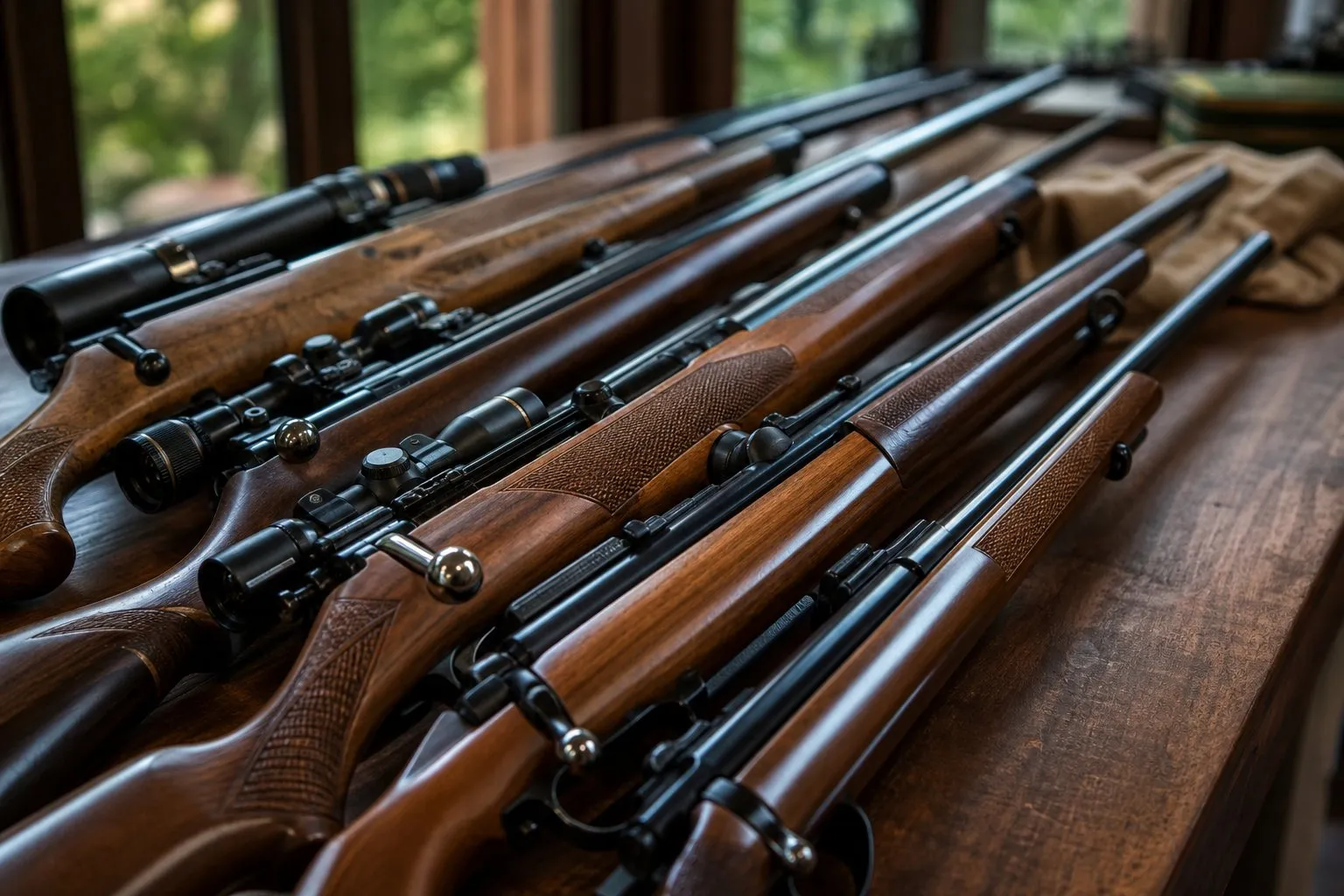
The Best Rifles in the World: A Comprehensive Guide to Elite Firearms in 2026
Rifles have shaped military history for generations. They keep evolving, thanks to fresh technology and clever design tweaks.
From classic designs that proved themselves over decades to modern platforms loaded with advanced features, these weapons really do represent the peak of firearm engineering. But figuring out what makes a rifle truly exceptional? That means looking at reliability, accuracy, and how it performs in the real world—no shortcuts there.
The best rifles in the world combine proven mechanical designs with practical features that work reliably in demanding conditions. I've taken a hard look at different platforms to figure out what really sets elite rifles apart from your standard military fare.
This includes poking into things like balanced recoil mechanisms, digging into the core characteristics that define excellence, and seeing how historical developments still shape modern rifle design.
1) AK-107 Kalashnikov derivative (5.45×39mm, balanced recoil system)
The AK-107 is a Russian assault rifle that stands out from other Kalashnikov variants. Developed in the 1990s, it runs on 5.45×39mm ammunition.
What really makes this rifle different is its balanced recoil system. The AK-107 features a counterbalanced mechanism borrowed from the AEK-971 design.
This system doesn't actually reduce the recoil from the bullet leaving the barrel. Instead, it counteracts the movement of the bolt carrier, which is a neat trick.
The balanced automatics system uses a second piston that moves in the opposite direction. This keeps the rifle steadier during automatic fire, which is honestly pretty clever—especially since it addresses a big problem with traditional AK designs.
The rifle was developed by Izhmash as part of the AK-100 series. Shooters can maintain better accuracy in full-auto because the system reduces internal movement, meaning less muzzle climb and quicker follow-up shots.
Russia also came up with the AK-108 variant chambered in 5.56×45mm NATO for export. Options, options.
Core Features That Define World-Class Rifles
So what separates a good rifle from a world-class one? In my experience, it boils down to three things: the materials, how consistently the rifle hits its mark, and the engineering behind its guts.
Materials and Craftsmanship
I've noticed that elite precision rifles depend on specific materials to hit their performance targets. Steel quality matters most for the barrel and action—chromoly and stainless steel are the usual go-tos for durability and accuracy.
Carbon fibre's pretty much the standard now for stocks on high-end rifles. It cuts weight but keeps things stiff, which definitely helps accuracy. Aluminium chassis systems are another solid choice, resisting warping when temperatures swing.
Machining tolerances really make or break a rifle. Bolt raceways cut to within thousandths of an inch make operation smooth and repeatable. Hand-lapping barrels removes those tiny imperfections that can mess with bullet travel.
Surface treatments like Cerakote or nitriding protect metal parts from corrosion and cut down on friction. These finishes extend the rifle's working life, especially if you drag it through mud and rain.
Precision and Accuracy
Accuracy is a team effort between several parts, but barrel quality stands out as the big one. Match-grade barrels get precise rifling and tight, consistent bore dimensions all the way through.
Free-floating barrels keep the stock from touching the barrel, so nothing messes with bullet trajectory. The barrel's only attached at the receiver—no weird pressure points to throw off your shot.
Trigger quality has a huge influence on accuracy. Top precision rifles usually have adjustable triggers with crisp, clean breaks—generally somewhere between 1.5 and 3.5 pounds. Any creep or mush introduces error, plain and simple.
Chamber tolerances matter too. Tight chambers that match ammo specs improve consistency shot after shot.
Innovative Mechanisms
Modern rifle actions have picked up some clever improvements for reliability and speed. Bolt actions with multiple locking lugs spread out the pressure and cycle smoothly, even when things get hairy.
Adjustable gas systems on semi-automatic platforms let shooters tune the rifle for different ammo or suppressors. That keeps over-gassing from wearing out parts or messing with accuracy.
Modular designs make customisation a breeze—no gunsmith needed. Quick-change barrels, adjustable length of pull, and interchangeable cheek risers let one rifle fit multiple shooters or jobs.
Tool-less adjustments are everywhere now. I can tweak stock dimensions, trigger weight, or gas settings in the field—no special tools required. Super handy, honestly.
Historical Impact and Evolution
Rifles have changed the way wars are fought and how hunters chase game. Key breakthroughs in technology have driven both military tactics and civilian shooting sports for centuries.
Advancements in Rifle Technology
The leap from flintlock muskets to modern precision rifles is honestly one of the wildest technological progressions out there. Rifling—those spiral grooves inside the barrel—massively boosted accuracy by spinning the bullet and keeping its flight path stable.
The mid-19th century saw breech-loading mechanisms replace the old, slow muzzle-loaders. Suddenly, soldiers could fire several rounds per minute instead of just a couple. Germany's Gewehr 98, their standard-issue rifle in World War I, featured a bolt-action design that became the gold standard for military rifles.
Magazine-fed repeaters totally changed battlefield tactics. Semi-auto and full-auto rifles followed, so you didn't have to manually work the action for every shot. Modern rifles now use synthetic materials, modular setups, and advanced optics mounting systems—stuff my grandfather wouldn't even believe.
Influence on Military and Sporting
Military forces around the world have always adopted rifles that played pivotal roles in major world events. These rifles forced armies to rethink everything, from line formations to more scattered infantry tactics. Long-range accuracy made cover, concealment, and suppressive fire way more important.
Sporting rifles evolved right alongside military ones. Target shooting even became an Olympic event, and hunters benefited from the same advances in reliability and accuracy. Civilian marksmanship programmes trained millions in solid shooting technique, building a culture of precision that still thrives.
The overlap between military and civilian rifle tech is still going strong. Plenty of sporting rifles borrow battle-tested designs for hunting or target work.
Frequently Asked Questions
Choosing a rifle comes down to what you need, who made it, and what kind of performance you're after. Calibre, platform, and whether it's for military, hunting, or defence all play a role—there's no one-size-fits-all.
Which manufacturers are regarded as producing the highest-quality rifles?
In my book, a handful of manufacturers really stand out for quality and innovation. Heckler & Koch has a reputation for rock-solid reliability and sharp engineering. Kalashnikov Concern keeps pushing the AK platform forward, adding things like the AK-107's balanced recoil system.
FN Herstal makes rifles for militaries all over, and Accuracy International is the go-to for long-range precision. Colt and Daniel Defense both turn out top-notch AR-platform rifles that military and civilian shooters trust.
What are the top ten rifles commonly ranked worldwide, and why?
The most reliable military rifles usually include designs that have proven themselves in combat. The HK416 gets high marks for reliability and modularity, and the AK-47 (plus all its spin-offs) is always on the list for its toughness.
The M4 carbine is everywhere because it's versatile and widely used. FN Herstal's SCAR series brings great ergonomics and adaptability, while the Steyr AUG nails bullpup efficiency.
The AR-15 platform dominates the civilian world for customisation. The AK-107 stands out for its balanced recoil system and 5.45×39mm cartridge. The FAL and G3 still get respect for their history and staying power.
What is typically considered the number one rifle overall?
Honestly, picking the best military rifle depends so much on context and what you need it for. The HK416 comes up a lot as a top contender, thanks to its mix of reliability, accuracy, and modular design. It fixes a lot of the classic AR-platform issues.
But calling any one rifle "number one" is a bit too simple, if you ask me. Different jobs, environments, and shooter preferences mean the best rifle for one person might not work for another. The AK platform is still king for reliability in rough conditions, while companies like Accuracy International own the long-range game.
Which assault rifles are most often rated as the best, and on what criteria?
The best assault rifles get judged mostly on reliability, accuracy, ergonomics, and how easy they are to maintain. When a rifle works every time, no matter the mud, sand, or rain, that's real reliability.
Accuracy isn't just about tight groupings at the range—it's also about whether the design actually helps you hit what you're aiming at. Some rifles just feel more dialed in, you know?
Ergonomics come into play with how fast and comfortably you can handle the thing. Weight, balance, where the controls sit—it all adds up, especially if you’re lugging it around for hours.
Maintainability? That’s about how quickly you can strip it down and get it running again, even with numb fingers or in a tent somewhere far from home.
Rifles like the HK416, AK-12, and SCAR-L tend to pop up near the top of most lists. The AK-107 deserves a mention too, mostly for its unusual recoil system that actually tames full-auto bursts.
What are the best rifles for home and personal defence in the UK context?
Honestly, UK firearms laws make rifle ownership for personal defence pretty much a non-starter. You can't legally keep a rifle just for self-defence—full stop.
If you want to own one, you need a firearms certificate, and those only get approved for things like target shooting or deer stalking. The rules are strict, and there's not a lot of wiggle room.
Some folks look at lever-action rifles in pistol calibres as a workaround. They're legal, and they do offer a bit of home defence capability, at least in theory.
Bolt-action rifles are another option, but only if you already have them for sport or pest control. Compared to other countries, UK residents just don't have many choices here.
It's clear the legal system in the UK cares way more about sport and pest control than personal protection. Anyone even thinking about getting a rifle over there really needs to read up on the rules first.
Which calibre is best suited to deer stalking and general hunting use?
I recommend .308 Winchester (7.62×51mm NATO) as the most versatile choice for deer stalking in the UK. It packs enough punch for all British deer species, yet most shooters find it pretty manageable.
Ammunition is everywhere, which makes life easier. The calibre also performs reliably at typical stalking ranges—no surprises there.
The .243 Winchester fits the bill for smaller deer species and has less recoil. I’d say it’s a solid pick for roe and muntjac deer, especially if you want something a bit gentler on the shoulder.
Lately, the 6.5 Creedmoor has been getting a lot of love for its impressive ballistic performance and accuracy. Not hard to see why folks are drawn to it.
When it comes to bigger red deer, some stalkers lean toward .270 Winchester or .30-06 Springfield for that extra bit of energy. It really boils down to what you’re hunting, how far you expect to shoot, and, honestly, what you like using.
In the UK, the law says you need at least .240 inches for smaller deer and .270 inches for the bigger ones. So, keep that in mind before heading out.