Longest Sniper Shots Ever Recorded: The Records, Rifles & Marksmen Behind Them
Discover the longest confirmed shots in military history, the rifles used, the extraordinary distances achieved, and the skilled marksmen who made them possible.
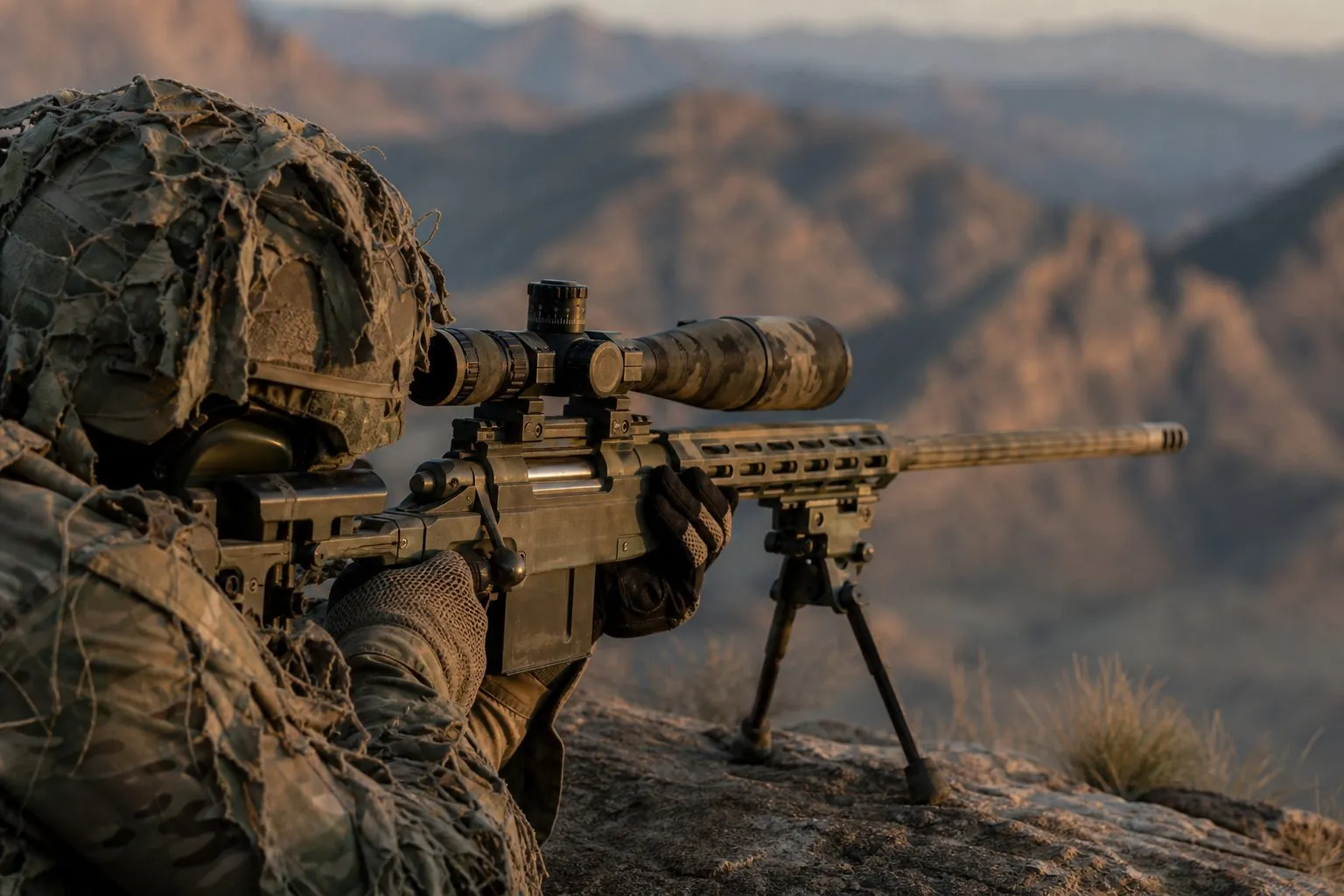
Longest Confirmed Shots by Western Armies: Records, Rifles, and Legends
The longest confirmed sniper kill in military history stands at 3,540 metres, achieved by a Canadian Joint Task Force 2 sniper in Iraq in 2017. This extraordinary shot demanded serious calculations—bullet drop, wind, atmospheric conditions, even the Earth's rotation came into play.
The bullet took nearly 10 seconds to reach its target. That’s a long time to wait for an outcome, isn’t it?
Western armies have dominated the record books for extreme-range sniper kills over the past two decades. Canadian snipers hold multiple positions in the top five longest-distance confirmed kills, with American and British marksmen also making their mark.
These aren't just numbers—they’re real battlefield feats, showing the ability to neutralise threats while minimising civilian casualties. The evolution of sniper rifles, optics, and ballistic tech keeps stretching what’s possible.
From Carlos Hathcock's legendary 2,286-metre shot in 1967—a record that stood more than three decades—to today’s ultra-precise weapon systems, snipers keep pushing the limits. Verifying these shots, understanding the gear, and appreciating the skilled teams behind them—there’s a lot more going on than meets the eye.
Key Takeaways
- Canadian snipers using the McMillan Tac-50 rifle hold the current world record at 3,540 metres
- Extreme-range shots require complex calculations for gravity, wind, atmospheric pressure, and the Coriolis Effect
- Modern sniper technology and training allow western armies to neutralise targets at distances exceeding two miles
Current and Historic Record-Holding Shots
The longest confirmed sniper kills have come a long way since World War II, when 1,100 metres was remarkable. Today, some records top 3,800 metres.
Ukrainian forces currently hold the top positions, but Canadian, British, American, and Australian snipers have all scored significant kills in Afghanistan and Iraq.
Ukrainian Milestones and Recent Breakthroughs
Ukrainian snipers have set the two most recent world records during the Russian invasion of Ukraine. In August 2025, an unnamed member of the "Pryvyd" (Ghost) sniper unit made a 4,000-metre shot with a XADO Snipex Alligator rifle chambered in 14.5×114mm.
This shot broke the previous record set in November 2023 by Viacheslav Kovalskyi, a 58-year-old sniper from Ukraine's Special Group "Alpha." Kovalskyi recorded a 3,800-metre kill during combat, using a Ukrainian-made Horizon's Lord rifle and custom 12.7×114 mm HL ammunition.
Ukrainian forces have logged other notable long-range kills, too. In November 2022, a Ukrainian National Guard sniper reached 2,710 metres with the XADO Snipex Alligator.
Canadian and British Sniper Achievements
Canadian snipers from Joint Task Force 2 set a remarkable record in May 2017. An unnamed operator made a 3,540-metre kill during the War in Iraq using a McMillan TAC-50 rifle with .50 BMG ammunition.
Earlier, Princess Patricia's Canadian Light Infantry notched major achievements in Operation Anaconda, March 2002. Corporal Rob Furlong hit 2,430 metres, and Master Corporal Arron Perry reached 2,310 metres—both with McMillan TAC-50s in Afghanistan.
British Corporal of Horse Craig Harrison set his own record in November 2009 with back-to-back 2,475-metre shots. Using an Accuracy International L115A3 rifle in .338 Lapua Magnum, he eliminated two Taliban machine gunners.
The rounds took nearly five seconds to get there—almost a lifetime in a firefight. These shots were 900 metres past the rifle’s recommended range, which is just wild.
Notable American and Australian Records
American military snipers have added their own long-range feats. Sergeant Brian Kremer of the 2nd Battalion, 75th Ranger Regiment made a 2,300-metre shot in October 2004 during the Iraq War, using a Barrett M82A1 rifle.
Specialist Nicholas Ranstad logged a 2,092-metre kill in January 2008 in Afghanistan. An unnamed Australian sniper from the 2nd Commando Regiment reached 2,815 metres in April 2012, also in Afghanistan, using a Barrett M82A1 with Raufoss Mk 211 .50 BMG rounds.
The Australian shot held third place globally until the Canadians topped it in 2017.
Legacy of World War II and Vietnam War Snipers
Carlos Hathcock set a foundational record in February 1967 during the Vietnam War. The US Marine Gunnery Sergeant hit 2,286 metres with a scoped, modified M2 Browning machine gun.
Hathcock’s record lasted 35 years. He scored 93 official kills and later helped found the Marine Corps Scout Sniper School at Quantico, Virginia.
He also won the 1966 Wimbledon Cup and kept serving even after being badly burned rescuing fellow Marines. World War II saw much shorter sniper shots by comparison.
German sniper Matthäus Hetzenauer held the longest confirmed kill of that conflict at 1,100 metres. It’s wild to see how much sniper tech and training have changed over the decades.
Weapons and Ammunition Used in Record Shots
The rifles and ammo behind these record shots all share a few things: they shoot large-calibre rounds, have long barrels for accuracy, and can handle the stress of extreme distances. Western militaries lean heavily on .50 BMG and .338 Lapua Magnum, while Ukrainian teams have gone even bigger with 14.5mm anti-materiel rifles.
McMillan TAC-50 and .50 BMG Dominance
The McMillan TAC-50 carved its place in history with the longest sniper rifle kill ever at 3,540 metres in Iraq, 2017. This bolt-action beast fires the .50 BMG (12.7×99mm NATO)—a round with enough punch to reach out past two miles.
The TAC-50’s design is all about long-range precision. It’s got a heavy match-grade barrel and a tough chassis to soak up the .50 BMG’s serious recoil.
The .50 BMG cartridge packs about 13,000 joules of muzzle energy. That’s why it can stay lethal at such crazy ranges.
Canadian snipers seem to love this rifle. Its edge comes from pairing great ammo with top-tier marksmanship.
Rounds like the Hornady A-MAX offer better ballistic coefficients than standard military stuff. That helps with accuracy when you’re fighting wind, air density, and the earth’s rotation at mile-plus distances.
Barrett M82A1, M82A3, and Other Anti-materiel Rifles
The Barrett M82 series is another legend in Western military sniping. An Australian sniper used a Barrett M82A1 for a confirmed kill at 2,815 metres in Afghanistan’s Helmand Province, April 2012.
This semi-auto .50 BMG rifle offers faster follow-up shots than bolt-actions, which is handy if you need to adjust quickly. The M82A1 and the updated M82A3 use a recoil-operated system to tame the kick, making it easier to reacquire targets between shots.
Officially, the rifle’s effective range is about 1,800 metres for point targets, but skilled shooters have pushed it much farther. Other Western anti-materiel rifles, like the Denel NTW-14.5, fire 14.5×114mm rounds similar to Ukrainian guns.
Still, most NATO forces stick with .50 BMG for simplicity and logistics.
Accuracy International L115A3 and the .338 Lapua Magnum
British Corporal Craig Harrison used an Accuracy International L115A3 to set a world record in 2009 at 2,475 metres in Afghanistan. This bolt-action rifle fires the .338 Lapua Magnum (8.6×70mm)—smaller than .50 BMG, but still packing a punch.
The L115A3 is all about precision. Its Schmidt & Bender 5-25×56 scope gives you the magnification to spot and hit distant targets.
The .338 Lapua Magnum sits between standard 7.62×51mm NATO and the massive .50 BMG, with about 6,700 joules of muzzle energy. Western snipers like it because it stays supersonic past 1,500 metres and doesn’t chew up barrels like .50 BMG does.
The McMillan TAC-338 is another .338 Lapua platform, though it hasn’t claimed any official records (yet).
Ukrainian Innovations: Snipex Alligator and Horizon's Lord
Ukrainian snipers have been shaking up the record books lately with their homegrown 14.5×114mm anti-materiel rifles. The XADO Snipex Alligator delivered a 4,000-metre kill in August 2025. Meanwhile, the Horizon's Lord rifle pulled off a 3,800-metre shot back in November 2023.
These rifles fire cartridges that started out in Soviet heavy machine guns. The 14.5×114mm round kicks out about 31,000 joules of muzzle energy—yeah, that's more than double the .50 BMG.
At 25 kilograms and sporting a 1,200mm barrel, the Snipex Alligator was supposed to be good for 2,000 metres, but Ukrainian snipers have gone way past that. It's a little wild to see how far they've pushed the limits.
The Horizon's Lord rifle's edge comes partly from custom-made ammo, which gives it better ballistics than the usual military rounds. Ukrainian forces have started using artificial intelligence and drone guidance to work out firing solutions at these insane ranges.
This approach is a big shift from the Western tradition, where snipers mostly rely on human spotters and ballistic calculators. It's not just about the shooter anymore—it's a whole tech ecosystem.
Verification and Confirmation of Sniper Records
Military organisations don't just take someone's word for a sniper record. They want physical documentation, witness statements, and usually video as well.
The standards keep getting tougher as tech makes longer shots possible and claims get wilder.
Criteria for Recognising Confirmed Kills
Western militaries check a bunch of boxes before adding a shot to the longest recorded sniper kills list. It's not enough for the round to hit—you need to prove the target was eliminated.
The key requirements include:
- Distance verification with GPS or laser rangefinders
- Visual confirmation of a neutralised target
- Witness statements from spotters or team members
- Video or photo evidence if possible
- Documentation about environmental conditions
Disputes about verification sometimes pop up when people rely on stories instead of hard proof. The chain of command reviews every claim before it becomes official.
And yeah, the shot has to be in combat against enemy combatants. Practice range shots don't count for these records.
Technological Tools for Distance and Impact Verification
Modern sniper teams bring a lot of gear to the table when they're chasing records. Laser rangefinders give you dead-on distance readings, sometimes across several kilometres.
Spotters use high-magnification scopes to watch the bullet strike and confirm hits at crazy ranges. Drones are in the mix now too, filming from all sorts of angles—just like in the 2025 Ukrainian record shot at 4,000 metres.
GPS units track exactly where the shooter and target are, so there's no arguing later. Some teams run ballistics computers that log every shot, building a digital record of the engagement.
Artificial intelligence steps in to crunch trajectories and even check hits using pattern recognition. It's a lot more high-tech than it used to be.
Peer Validation and Documentation in Western Militaries
Getting a sniper kill record recognised takes more than just a good shot. Multiple people in your unit have to back you up.
British, Canadian, and Australian forces all require spotters to confirm both distance and impact before you can submit a claim. Canadian Joint Task Force 2 kept things airtight when their sniper made a 3,540-metre shot in Iraq in 2017.
They included video, written reports, and statements from everyone who saw it. Western armies usually want:
- Written reports from the shooter
- Spotter confirmation
- Commander verification
- Supporting technical data
Craig Harrison's record (2009–2017) went through a pretty intense review before the British Army signed off. The process keeps the records legit and weeds out anything sketchy.
The Role of Sniper Teams and Technology
Modern long-range sniping is about way more than just a good rifle and a steady hand. Specialized gear like laser rangefinders and ballistic calculators play a huge role.
Wind speed and air density can totally change a bullet's path, so measuring those is non-negotiable.
Spotters and Ballistic Calculators
Let's be real: nobody pulls off record shots solo. Every sniper team has a spotter, glued to a high-powered scope, calling out targets and watching for impacts.
The spotter figures out wind, distance, and weather, while the shooter just tries to stay still and breathe right. Ballistic calculators have made life easier, crunching numbers for elevation and windage so you don't have to do it all in your head.
These handheld gadgets take data about ammo performance, muzzle velocity, and current conditions to spit out an aiming solution. Still, sniper tech can't replace a well-trained human.
Laser rangefinders give you instant distance, no guessing. With meteorological data and ballistic software, you can cut down the circular error probable (CEP)—that’s the radius where half your shots land.
Meteorological Instruments and Environmental Factors
Long-range sniping is all about reading the environment. Handheld weather tools measure temperature, barometric pressure, humidity, and wind right where you’re shooting.
These numbers feed into your ballistic predictions, adjusting for air density. Wind, though, is the big headache.
It can shift wildly along the bullet's flight path, sometimes lasting several seconds on shots over 2,000 metres. You’re stuck estimating conditions between you and the target, since your instruments only know your own spot.
At really long ranges, the Coriolis effect (thanks, Earth’s rotation) starts to matter. It nudges bullets off course, so you have to compensate for that too. Elevation differences between shooter and target also mess with your calculations.
Drones and Artificial Intelligence Integration
Modern sniper teams use UAVs and AI for target finding and ballistic math at ranges beyond 3,000 metres. Drones feed you live intel on wind all along the bullet's path—not just at your feet.
AI systems chew through data way faster than any human. They analyse weather, ammo performance, and past shots to sharpen your aim.
Ukrainian forces have really shown what this combo can do, with that confirmed 4,000-metre shot in August 2025. The blend of unmanned tech and AI is stretching engagement ranges and speeding up the whole process.
Profiles of Legendary Western Snipers
Some Western military snipers have pulled off jaw-dropping kills at distances that almost seem unreal. These shooters have set records from Vietnam all the way to recent wars, with shots from 2,286 metres to past 3,800 metres.
Carlos Hathcock: Vietnam War Marksman
Carlos Hathcock really laid the groundwork for today’s long-range sniping during the Vietnam War. In February 1967, he scored a confirmed kill at 2,286 metres with a M2 Browning machine gun firing .50 BMG.
His record stood for 35 years, which is wild. Beyond that one shot, Hathcock racked up 93 official kills with the 7th Marine Regiment, 1st Marine Division.
He came back from Vietnam and helped start the Marine Corps Scout Sniper School at Quantico, Virginia. Even after suffering severe burns while saving fellow Marines and later battling multiple sclerosis, he kept teaching and serving.
Hathcock also won the 1966 Wimbledon Cup for the US 1,000-yard high-powered rifle National Championship. Guy was a legend, no question.
Rob Furlong and Arron Perry: Canadian Record Holders
Two Canadian snipers toppled Hathcock's record just days apart during Operation Anaconda in Afghanistan. Master Corporal Arron Perry got a confirmed kill at 2,310 metres in March 2002 with a McMillan TAC-50 rifle in .50 BMG.
Corporal Rob Furlong upped the ante days later with a 2,430-metre shot using the same setup. Both were with the 3rd Battalion, Princess Patricia's Canadian Light Infantry, working as part of a six-man sniper team.
The TAC-50 wasn't done yet. In May 2017, an unnamed Canadian special forces sniper from Joint Task Force 2 hit a 3,540-metre kill in Iraq—nearly 800 metres beyond the old record.
Craig Harrison: British Record-Breaker
Corporal of Horse Craig Harrison raised the bar in November 2009, serving with the Blues and Royals, Household Cavalry. He
Impact, Controversies, and Future of Long-Range Sniping
Western military snipers have changed the game for how armies do reconnaissance and precision strikes. The chase for ever-longer shots has kicked off debates about verification standards and whether all this tech is starting to overshadow old-school marksmanship.
Influence of Western Sniping on Modern Warfare
Look over the longest sniper shots and you'll see Western forces ruled the record books for years. Canadian snipers held the top spot for a long time, especially with a Joint Task Force 2 operator making a 2.19-mile kill in Iraq in 2017.
British and Australian snipers grabbed their own records too. Craig Harrison of the British Army set a world record in 2009 at 1.53 miles in Afghanistan, and an Australian 2nd Commando Regiment sniper later stretched it to 1.74 miles in 2012.
These feats changed how Western militaries think about tactics. Commanders started to realize snipers could reach out and touch threats at distances nobody thought possible.
The psychological effect is huge. Enemy troops have to worry about getting hit from more than two miles away, which totally changes how they move and set up defenses.
Debates on Verification and Technological Assistance
You'll find that verification of sniper kill records is still a hot topic in military circles. Video evidence is now basically the gold standard, but not every military is keen to release those videos—operational security and all that.
The rise of AI-assisted targeting systems has opened up a can of worms about what even counts as a "sniper shot" anymore. Ukrainian forces using artificial intelligence and drone guidance snagged the latest record at 2.49 miles in August 2025, which was apparently the first confirmed kill where AI lent a hand.
Critics say all this tech takes away from classic skills like wind reading and range estimation. But honestly, snipers have always grabbed whatever tech they could, from rangefinders to advanced optics, so is it really that different now?
Evolution of Anti-materiel and Specialist Rifles
Access to purpose-built platforms has really changed the game for long-range shooting. The McMillan TAC-50, used by Canadian forces, is now almost legendary for extreme-distance precision.
This .50-calibre anti-materiel rifle started out as a tool for wrecking equipment, not people. Ukrainian manufacturers have since developed the XADO Snipex Alligator, a 14.5mm rifle that's broken records more than once.
Even though it's rated for 2,000 metres, Ukrainian snipers have managed to double that in actual combat. Wild, right?
Key Anti-materiel Rifles:
- McMillan TAC-50: .50-calibre, effective to 1,800 metres
- Barrett M82A1: .50-calibre, proven in Afghanistan
- XADO Snipex Alligator: 14.5mm, Ukrainian-made
- Accuracy International L115A3: .338 Lapua Magnum
These rifles are absolute beasts, tipping the scales at 25 kilograms or more. You need a team to run them, not just one person.
Now, your ability to hit targets at distance depends less on what the rifle can do, and more on reading the environment and crunching some serious ballistics.
Frequently Asked Questions
The longest confirmed sniper kill in military history sits at 3,540 metres, made by a Canadian sniper in 2017. American forces have logged kills past 2,000 metres too, using specialised gear and strict verification.
What is the longest confirmed sniper shot ever recorded, and what was the verified distance?
A Canadian Joint Task Force 2 sniper holds the longest confirmed kill shot since 2017. That shot stretched 3,540 metres and took out an ISIS target in Iraq.
The Canadian Armed Forces confirmed it with video footage and official statements. The operation shut down an attack on Iraqi security forces and avoided civilian casualties.
This record leapfrogged previous marks set by other western snipers. The top five longest-distance confirmed kills all passed the one-mile mark, and the top two went over two miles.
Which western military unit currently holds the record for the longest confirmed sniper engagement?
Joint Task Force 2—Canada's elite special ops—still holds the record. Their sniper pulled off the 3,540-metre shot in 2017 during operations against ISIS.
Before that, British forces were in the lead. Craig Harrison from the Blues and Royals set the bar from 2009 to 2012 with a 2,475-metre shot in Afghanistan.
Canadian Special Operations Command confirmed their record, but they keep the nitty-gritty details under wraps for security. Worth noting: several Canadian snipers have pulled off extreme-range shots with similar gear and training.
What is the longest confirmed shot in United States military history, and how was it authenticated?
American snipers have notched confirmed kills past 2,000 metres in Iraq and Afghanistan. These shots sit among the longest confirmed kills in military history.
US military authorities check long-range kills with several methods—witness accounts, target confirmation, and documentation of environmental conditions.
They keep detailed records of distance measurements, equipment, and how the engagement played out. That's part of why some wild shots never make it into the official books.
How do militaries confirm and verify the distance and conditions of an extreme-range shot?
Military authorities want hard proof for long-range kills. They look for video, witness statements, and GPS data to verify everything.
The process documents the distance, target, and environmental factors. They also check what gear was used and exactly where the shooter was set up.
For the Canadian record, video footage sealed the deal. Officials measured the distance with mapping tech and made sure the shot fit operational goals.
Operational security means they rarely spill all the details publicly. Info about shooting distances and sniper IDs has been out there since 1967, but only in bits and pieces.
What rifles, optics, and ammunition have been used in the longest confirmed sniper shots by western forces?
The McMillan Firearms Tac-50 shows up in three of the five most recent record shots. Canadian snipers used this rifle in all three, including the current record-holder.
The Tac-50 fires .50 calibre rounds and mixes the punch of an anti-materiel rifle with real precision. Since its debut in 2000, it's changed what long-range shooting can be.
Advanced optics help snipers pick out targets at incredible distances. Sure, a .50 calibre round could theoretically go five miles if everything's perfect, but actually hitting something that far? Almost impossible.
Specialised ammo matters a lot, too. Western militaries put a ton of effort into making rounds that stay stable way downrange.
How do wind, air density, and bullet drop affect shot placement at record-breaking distances?
Bullet drop really starts to matter past 2,000 metres. Gravity keeps tugging the projectile downward, so shooters have to make careful elevation tweaks.
When you’re trying to hit a target 3,540 metres away, windage adjustments can go over 360 inches. Wind isn’t exactly predictable either—speed and direction can shift all along the bullet’s flight path, which complicates things fast.
Air density changes how the bullet slices through the sky. Stuff like altitude, temperature, and pressure all play a part in the drag the projectile faces.
The Coriolis Effect comes into play too, thanks to the Earth’s rotation. At those wild distances, this subtle hemispheric drift can nudge bullets off target if you don’t factor it in.
Honestly, you’re juggling all these variables at once if you want to land a shot. Even a tiny error through the scope could mean you miss the mark by a mile—well, almost literally at these ranges.